Where Seoul Locals Actually Go: Gwangjang Market to Euljiro
On a Saturday in October we started at Gwangjang Market at half past four and finished in Euljiro after dark, and the thing we kept noticing was who was around us. Almost everybody was Korean.
This is the whole walk, as a film from our channel GRACE H.R — nine minutes, no narration, no talking over it:
Where Seoul Locals Actually Go | Gwangjang Market → Euljiro · 9:43 · filmed Saturday 3 October 2026, 16:30 to night.
And this is the guide to doing it yourself: eight stops, every address, what we actually paid, and the one thing you should know about prices at Gwangjang before you order anything.
The route, in one line
Gwangjang Market (eat) → the food alleys (walk) → yukhoe alley (eat again, or just look) → Cheonggyecheon stream (walk west, catch the sunset) → Euljiro (grill alley, then neon, then a bar).
Door to door it is about 2.5 kilometres and it took us five and a half hours, most of which was sitting down. Start at 17:00 and the sun sets on the stream at roughly the right moment and you arrive in Euljiro as the lights come on. That timing is the whole trick and it is the only piece of planning this day needs.
1. Gwangjang Market — and the price thing
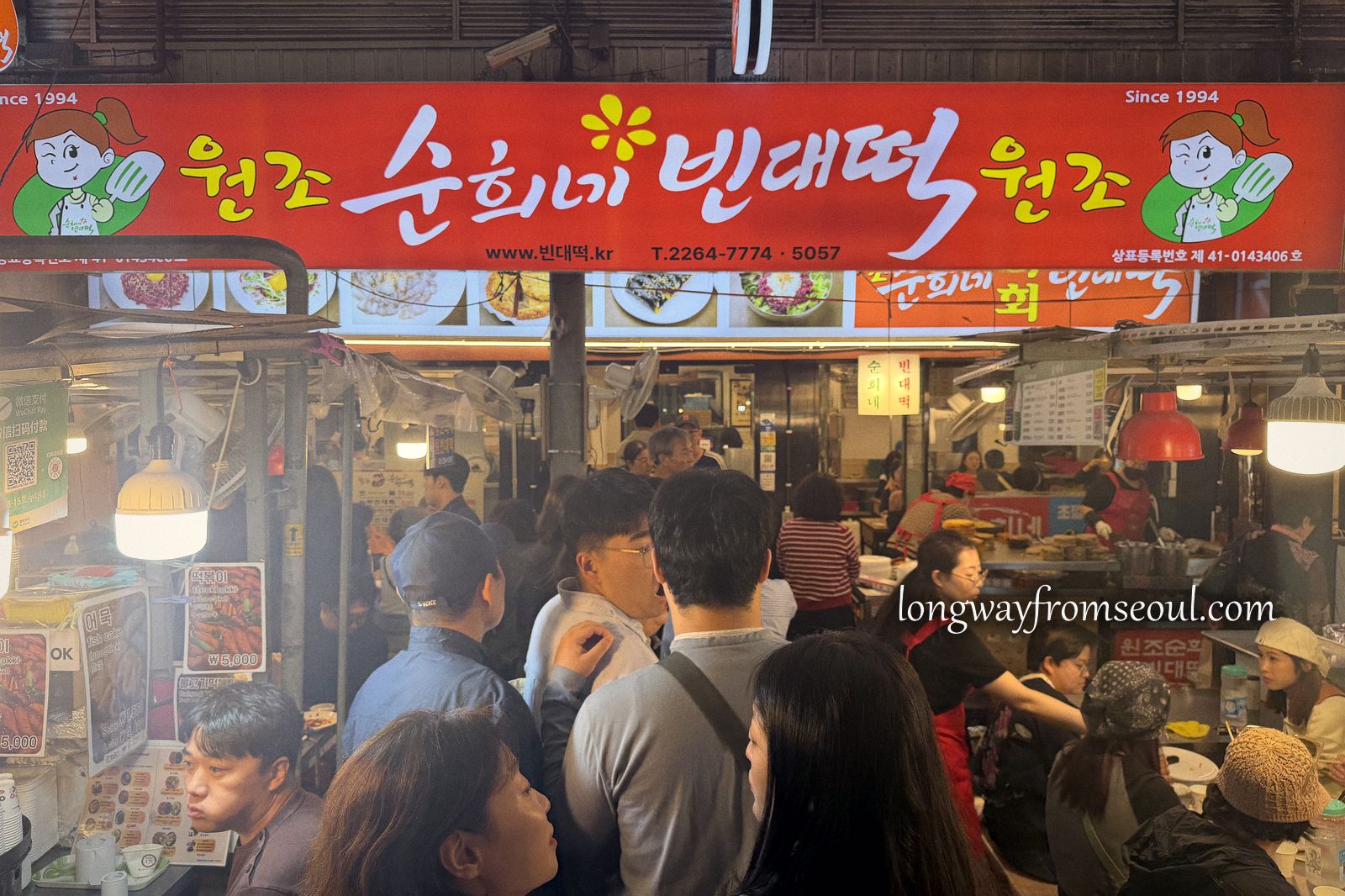
Gwangjang is the oldest permanent market in Seoul. The company that built it was founded on 5 July 1905 by Korean merchants who had lost control of Namdaemun Market under Japanese occupation and wanted one of their own. Its innovation was boring and enormous: it opened every day, when markets at the time opened occasionally. It was called Dongdaemun Market until 1960, when it took the name Gwangjang.
You are going for the food alley, which is a covered grid of stalls selling bindaetteok (mung bean pancakes), mayak gimbap, tteokbokki, raw beef, and live octopus, with low stools pulled up to the counter.
Read this before you order
In April 2026 a foreign YouTuber was charged 2,000 won for a 500ml bottle of water at Gwangjang and the clip went around the world. The vendor was suspended for three days. It was not the first story of its kind.
On 20 May 2026 the Seoul Metropolitan Government and Jongno District Office announced a joint crackdown: undercover “mystery shoppers” in both Korean and foreign guise, inspections of 159 licensed restaurants and 109 street carts, and immediate suspension or heavy fines for vendors who fail to display prices clearly. From June 2026 stalls are tied to a verified operator with demerit points attached. The city said it was not a one-time sweep.
What that means for you, practically:
- Prices must be displayed. If a stall has no visible price list, that is now a reportable problem, not a quirk. Walk to the next one.
- Ask the price before you accept anything — including water, including a side dish that appears without being ordered.
- Pay by card. Every stall we used took cards, and a card receipt is an itemised record. This is the single easiest protection.
- Be fair about it too: the overwhelming majority of these stalls are run honestly by people who have been there for decades, and the ones that are not have made life worse for all of them.
We were not overcharged anywhere on this walk. We also checked every price before we ordered, which is the point.
Where we ate: Sunhui-ne Bindaetteok
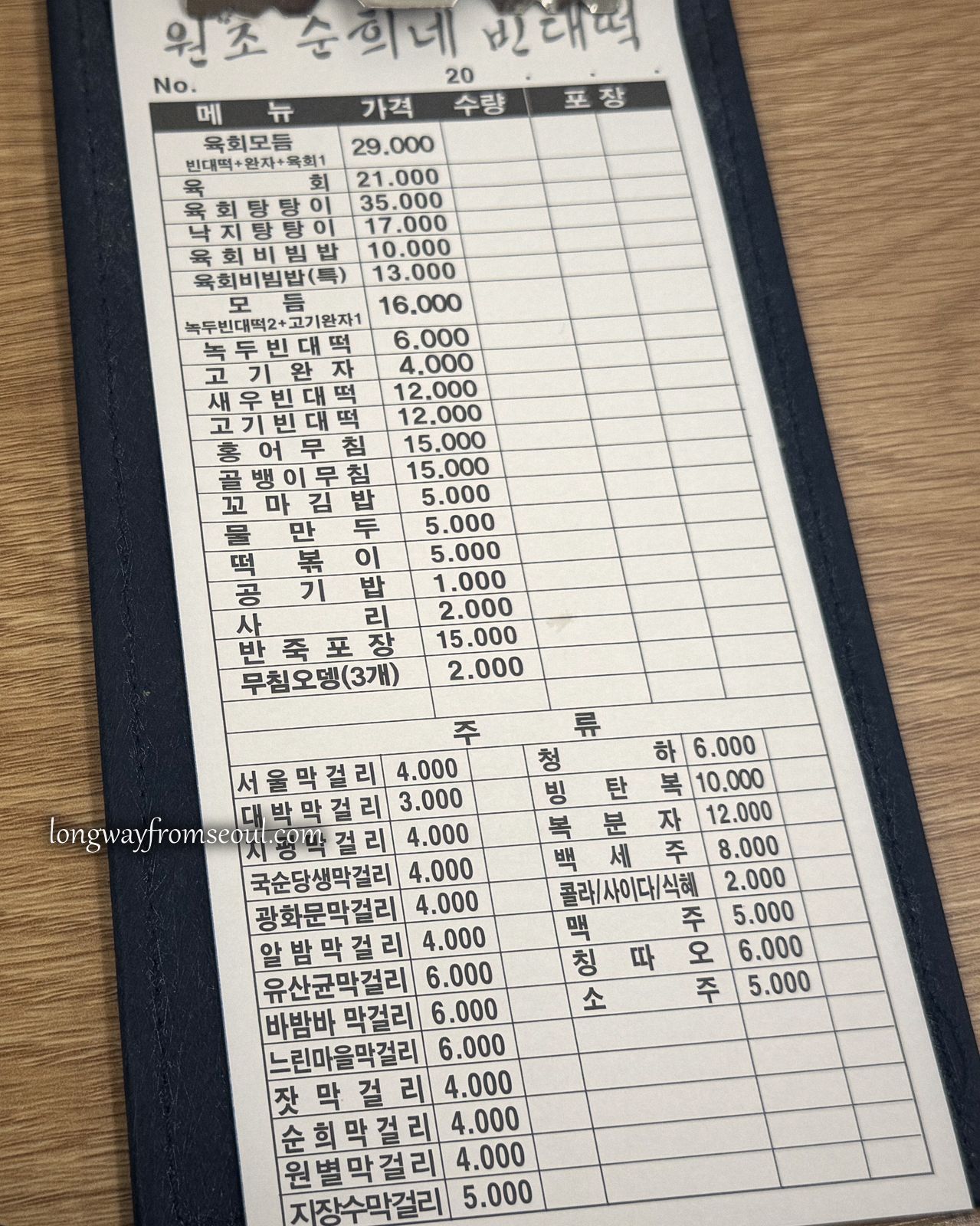
You do not order by speaking. A clipboard comes with a printed sheet, you write the quantity next to what you want, and you hand it back. It is the easiest ordering system in Korea for a foreign visitor, because the prices are right there in front of you in print.
Here is what was actually on that sheet on 3 October 2026 — this is a photograph of their own order form, not a figure copied off another blog:
- Nokdu bindaetteok (mung bean pancake) — 6,000 won
- Meat patty (gogi wanja) — 4,000 won
- Shrimp or meat bindaetteok — 12,000 won
- Combo: two mung bean pancakes + one meat patty — 16,000 won
- Yukhoe (raw beef) — 21,000 won · yukhoe bibimbap — 10,000 won
- Mini gimbap, dumplings, tteokbokki — 5,000 won each
- Makgeolli — 3,000 to 6,000 won depending on the bottle · beer 5,000 · soju 5,000
- Cola / cider / sikhye — 2,000 won
Two people eat and drink well here for about 20,000 won. Card worked.
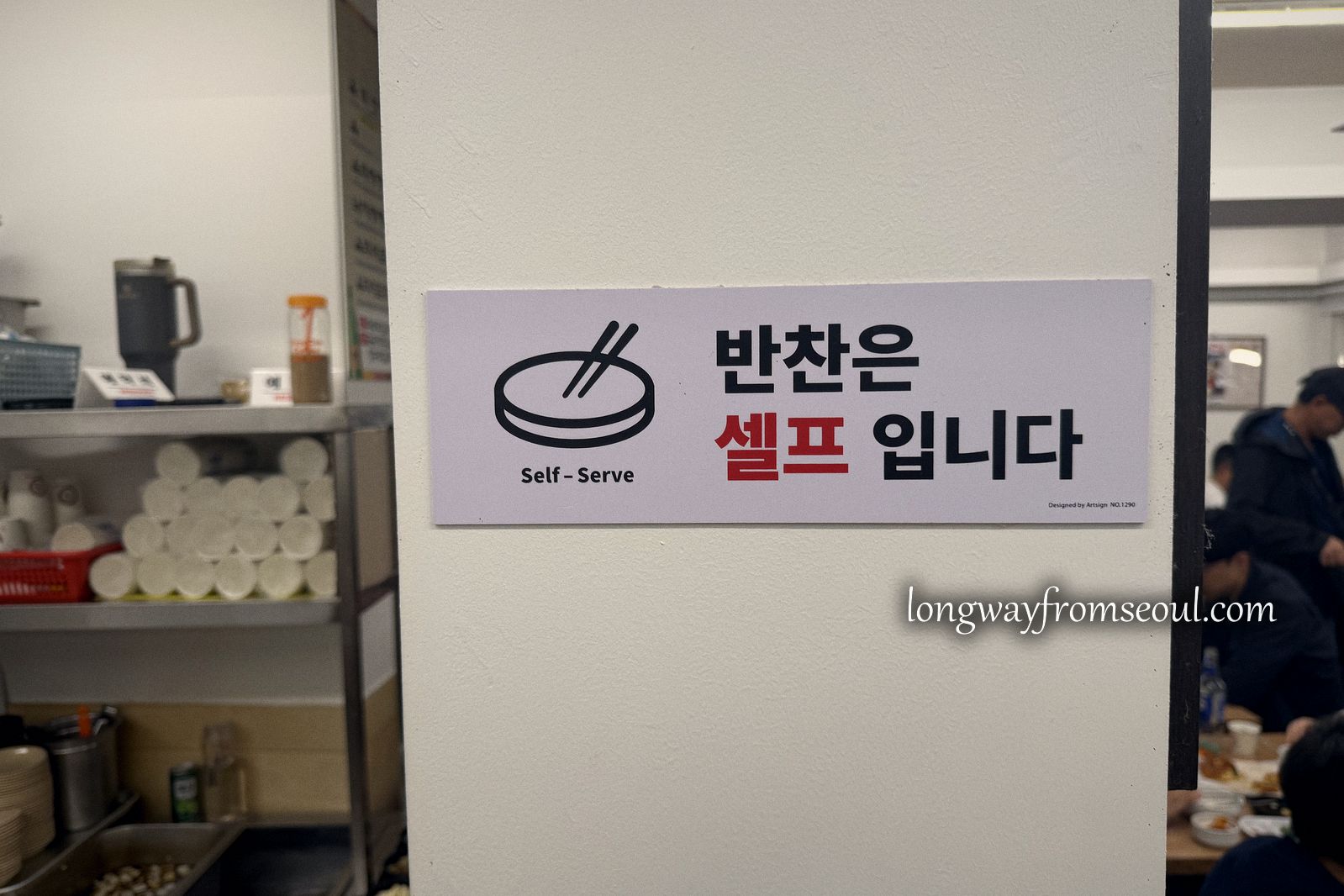
The sign says banchan is self-serve. You get your own side dishes from the steel trays at the end of the counter and nobody will bring them to you. Nothing you take from there is charged for.
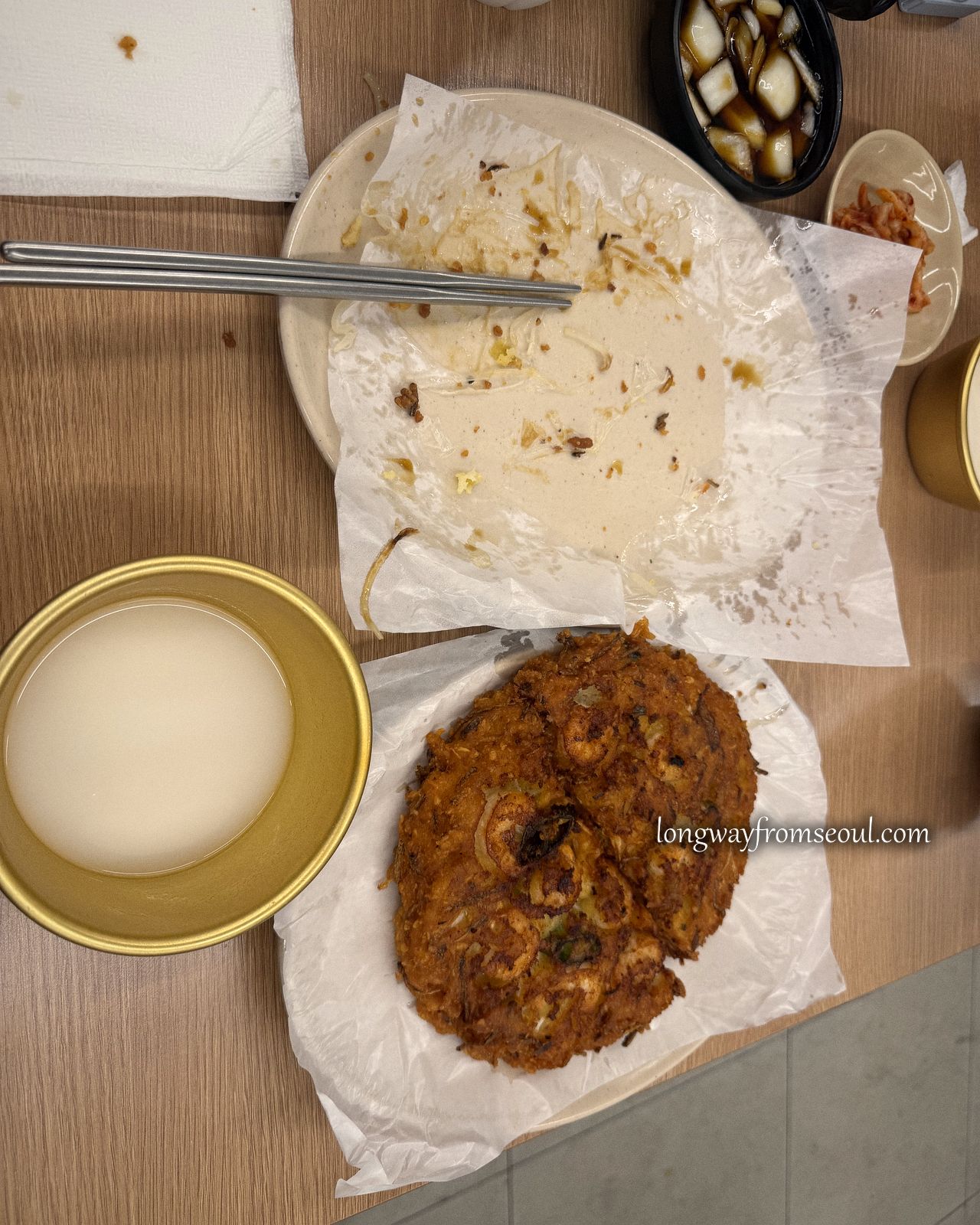
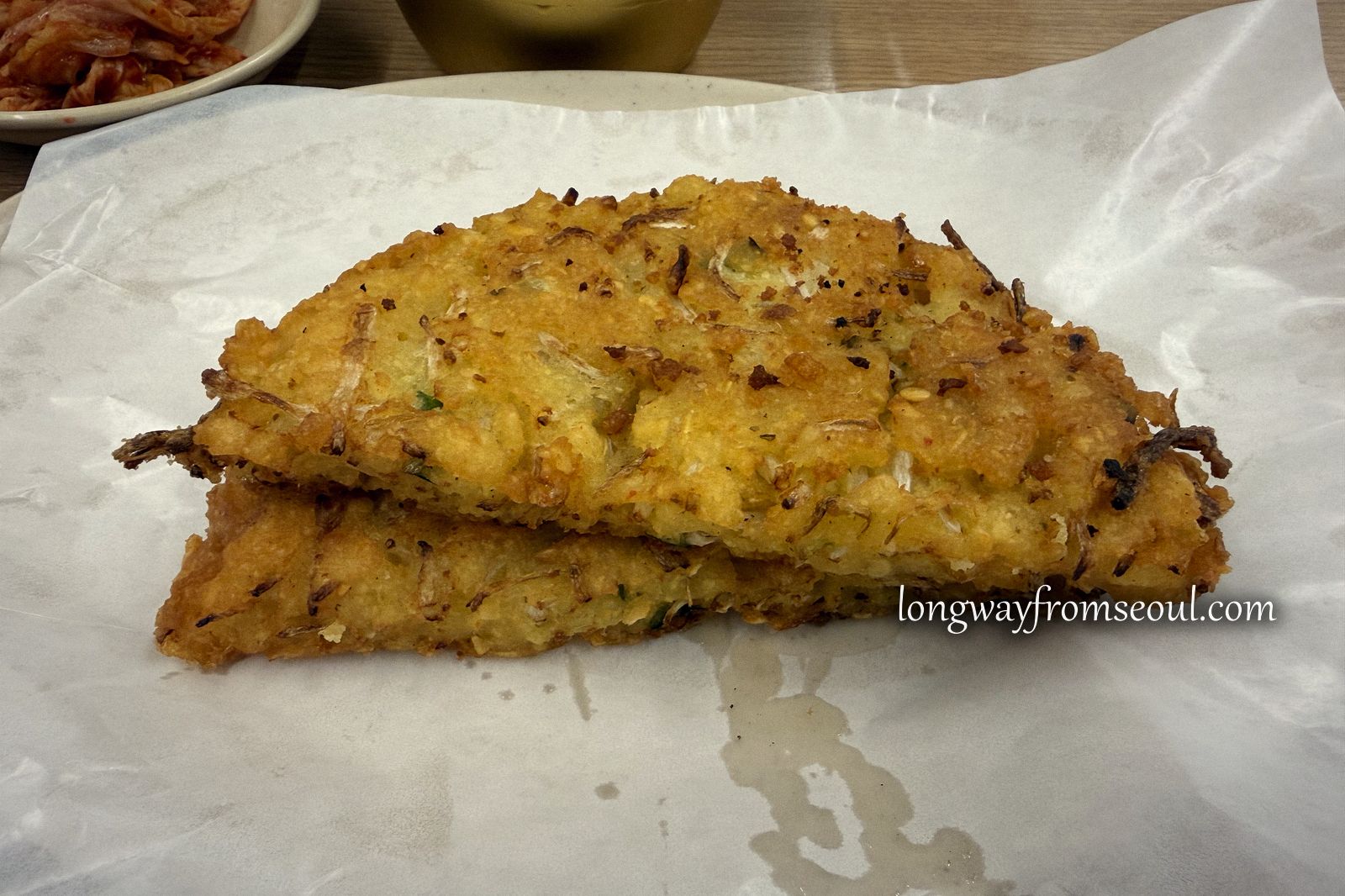
The pancake comes on a sheet of paper, cut into wedges, with a soy-and-onion dipping sauce. The correct drink is makgeolli, served in a brass bowl, and at 4,000 won a bottle there is no reason not to.
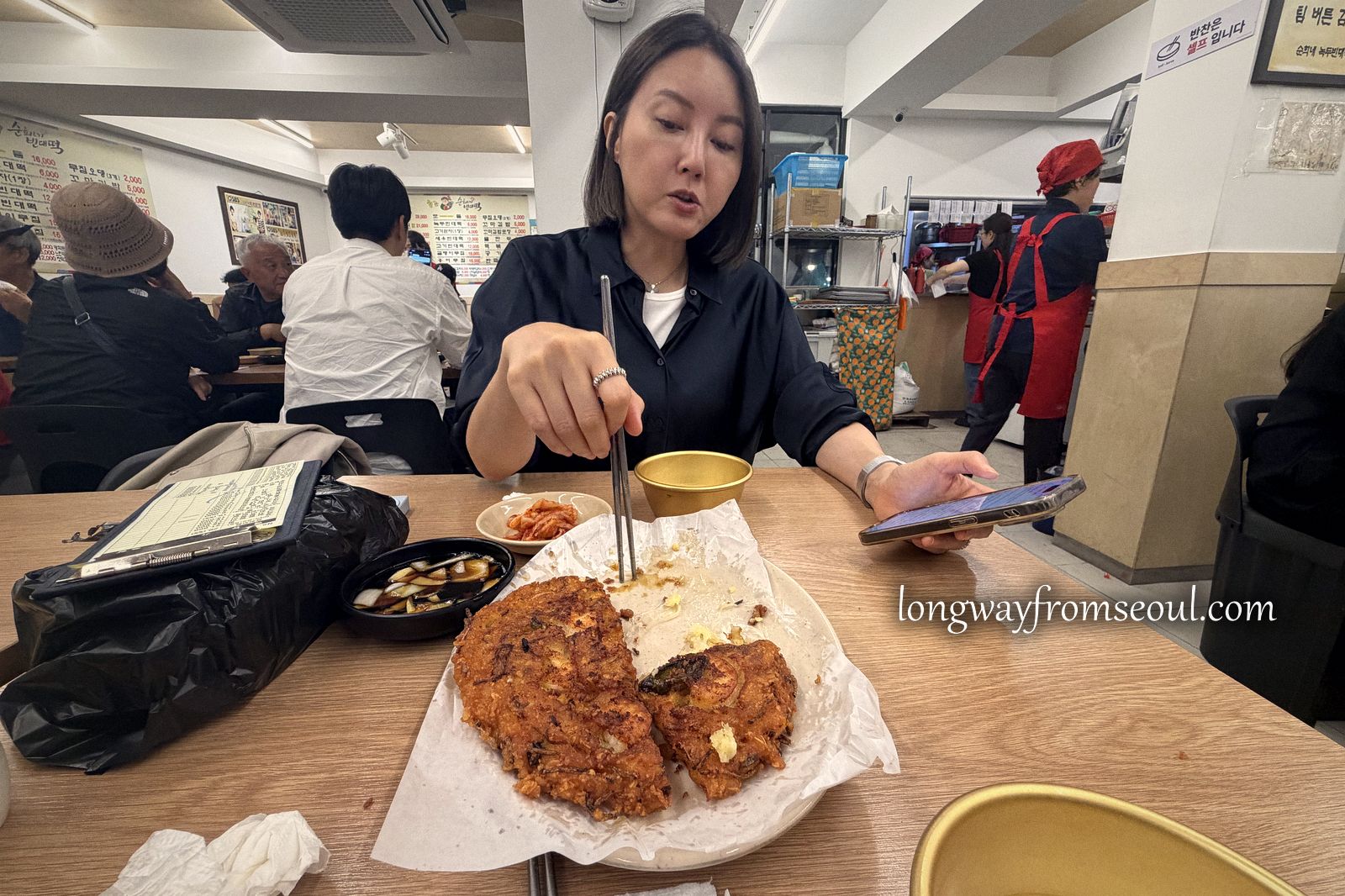
Sunhui-ne Bindaetteok · 순하네 빈대띓
5 Jong-ro 32-gil, Jongno-gu, Seoul 03195 — inside Gwangjang Market
Open in Google Maps · Order on the paper sheet · card and cash · busiest 18:00–21:00
→ Guided Gwangjang Market food tours and market walks
2. The food alleys — walk them before you decide
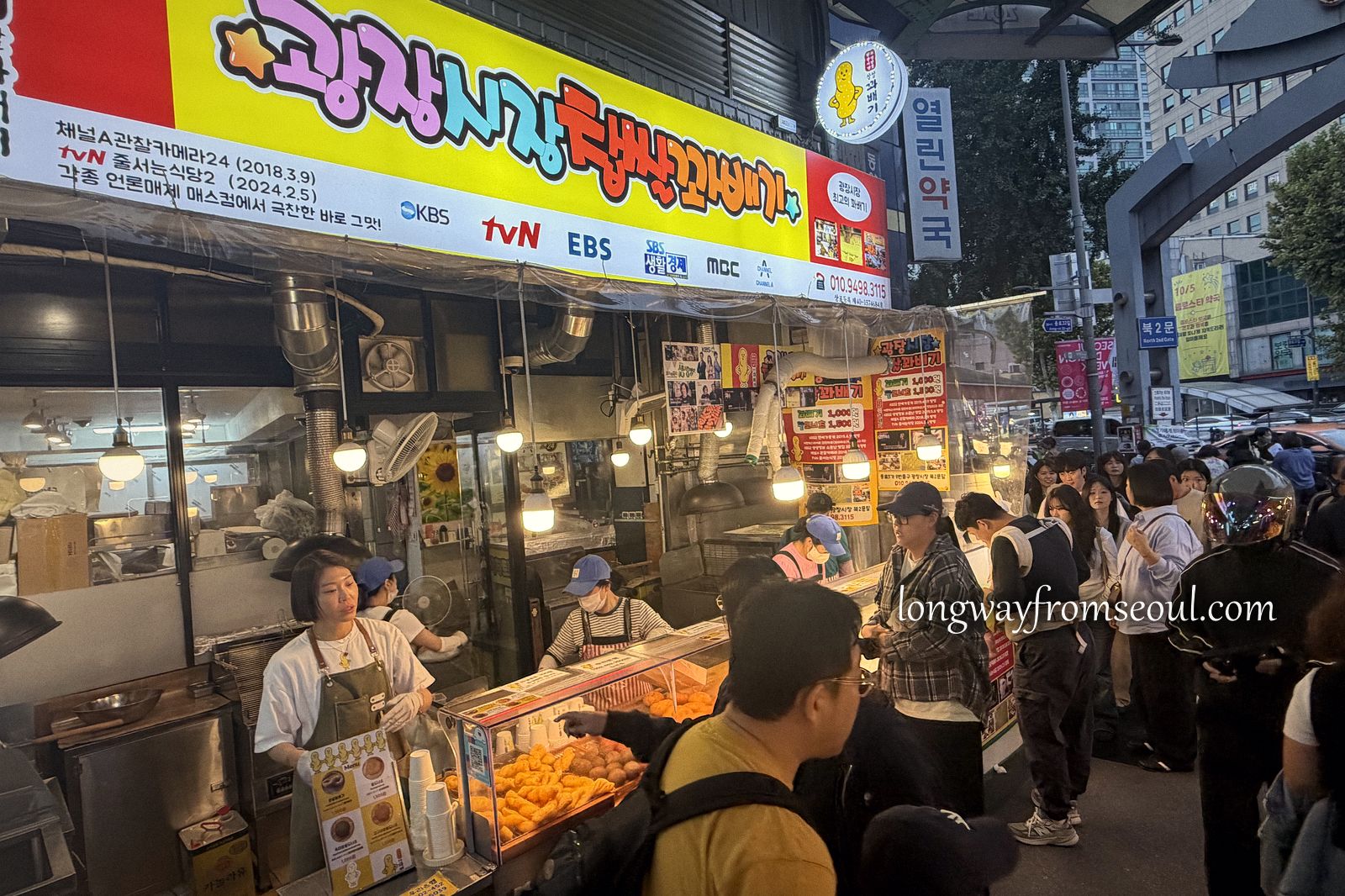
Our mistake the first time we came here years ago was eating at the first stall we saw. Do a full lap first. The market is small enough that a lap takes ten minutes and it completely changes what you order.
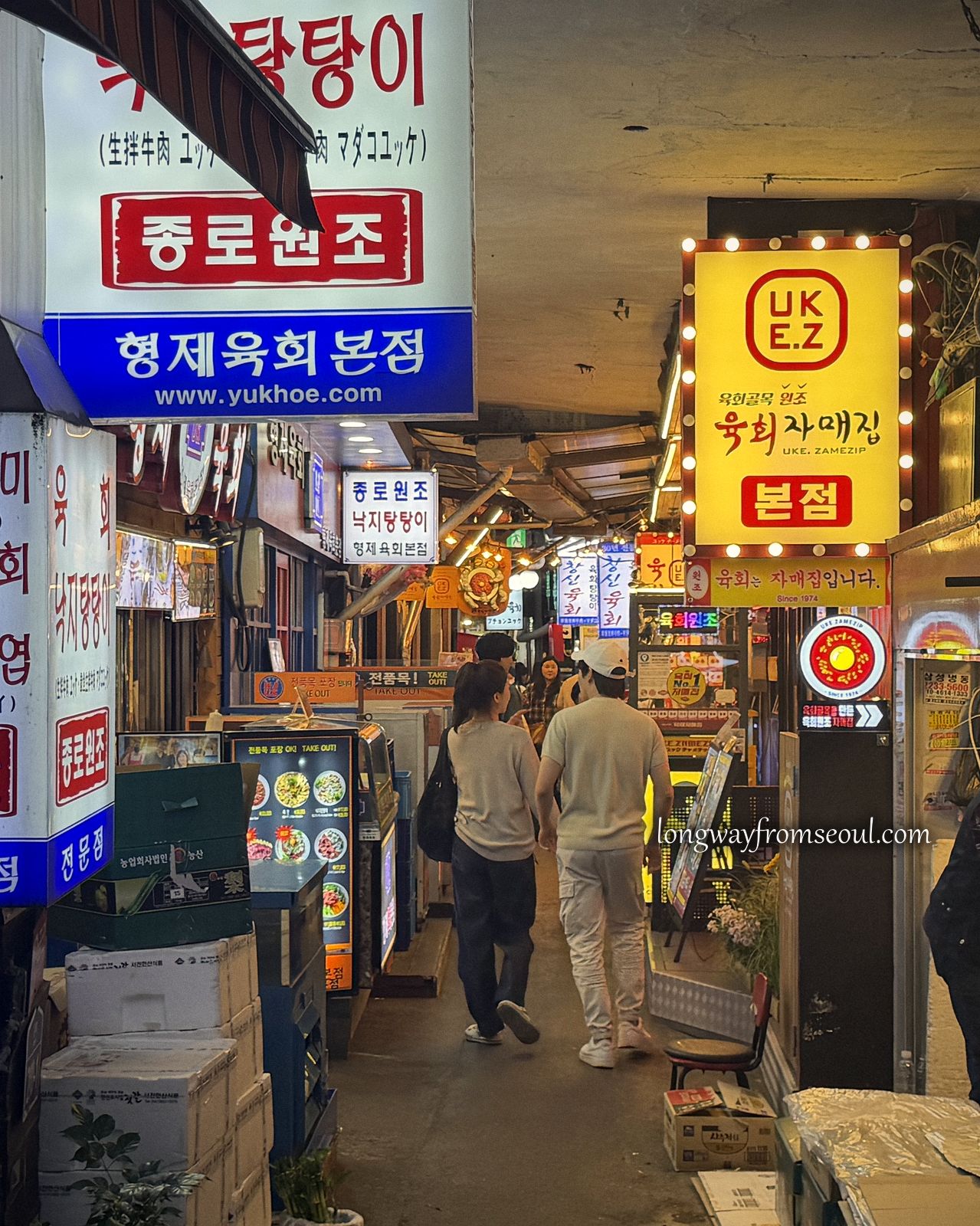
Things worth looking for on the lap: the woman cutting mayak gimbap at speed, the bindaetteok griddles with a centimetre of oil on them, the tanks of live octopus, and the stalls where the queue is entirely Korean. That last one is the only review system that has never let us down.
Gwangjang Market food alleys · 광장시장
88 Changgyeonggung-ro, Jongno-gu, Seoul — Jongno 5-ga station (Line 1), exit 8
Open in Google Maps · Food Alley 09:00–23:00 daily · general shops 09:00–18:00, closed Sundays · vintage floor 10:00–19:00, closed Sundays (Visit Seoul)
3. Yukhoe alley — raw beef, and whether you should
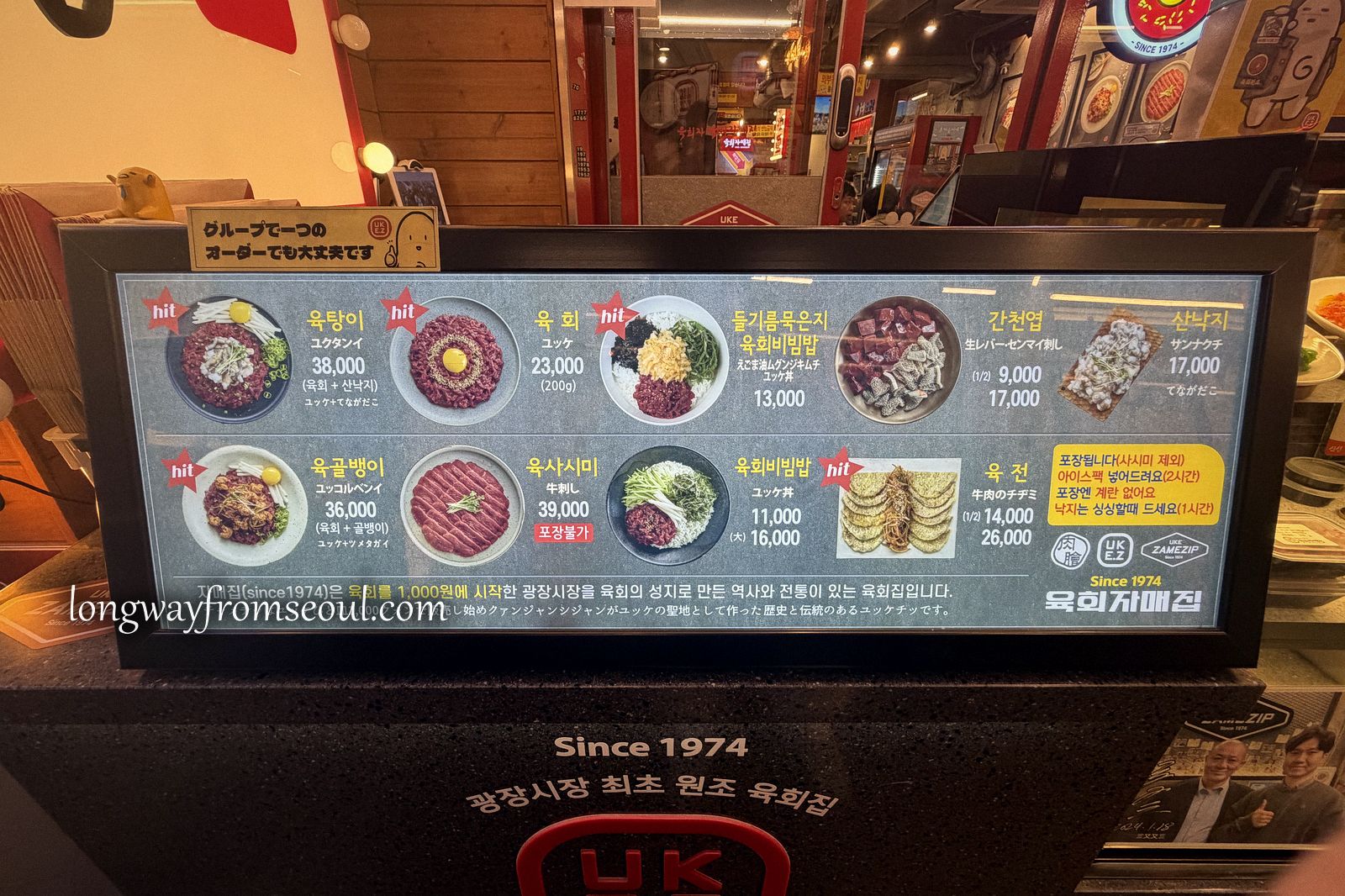
A short alley at the Jongno side of the market is given over almost entirely to yukhoe: Korean raw beef, hand-cut, dressed with sesame oil, soy, pear and garlic, served cold with a raw egg yolk on top. It is not steak tartare, and it is not trying to be.
The board at Yukhoe Jamae-jip reads Since 1974 and calls the shop Gwangjang’s first yukhoe house; its own copy says it started selling yukhoe at 1,000 won a plate and turned the market into, in their words, the holy ground of yukhoe. Prices from that board on 3 October 2026:
- Yukhoe, 200g — 23,000 won
- Yukhoe bibimbap — 11,000 won (large 16,000)
- Yukhoe + live octopus — 38,000 won · yukhoe + sea snails — 36,000 won
- Beef sashimi — 39,000 won (eat in only, no takeaway)
- Beef jeon (pancake) — 14,000 won for a half portion
Two details off the same board that are genuinely useful. One order is fine for a group — they say so in Japanese on a card at the counter, so you are not forced into one dish per person. And most of it travels: they pack it with an ice pack good for about two hours, minus the egg, though they ask you to eat the octopus within the hour.
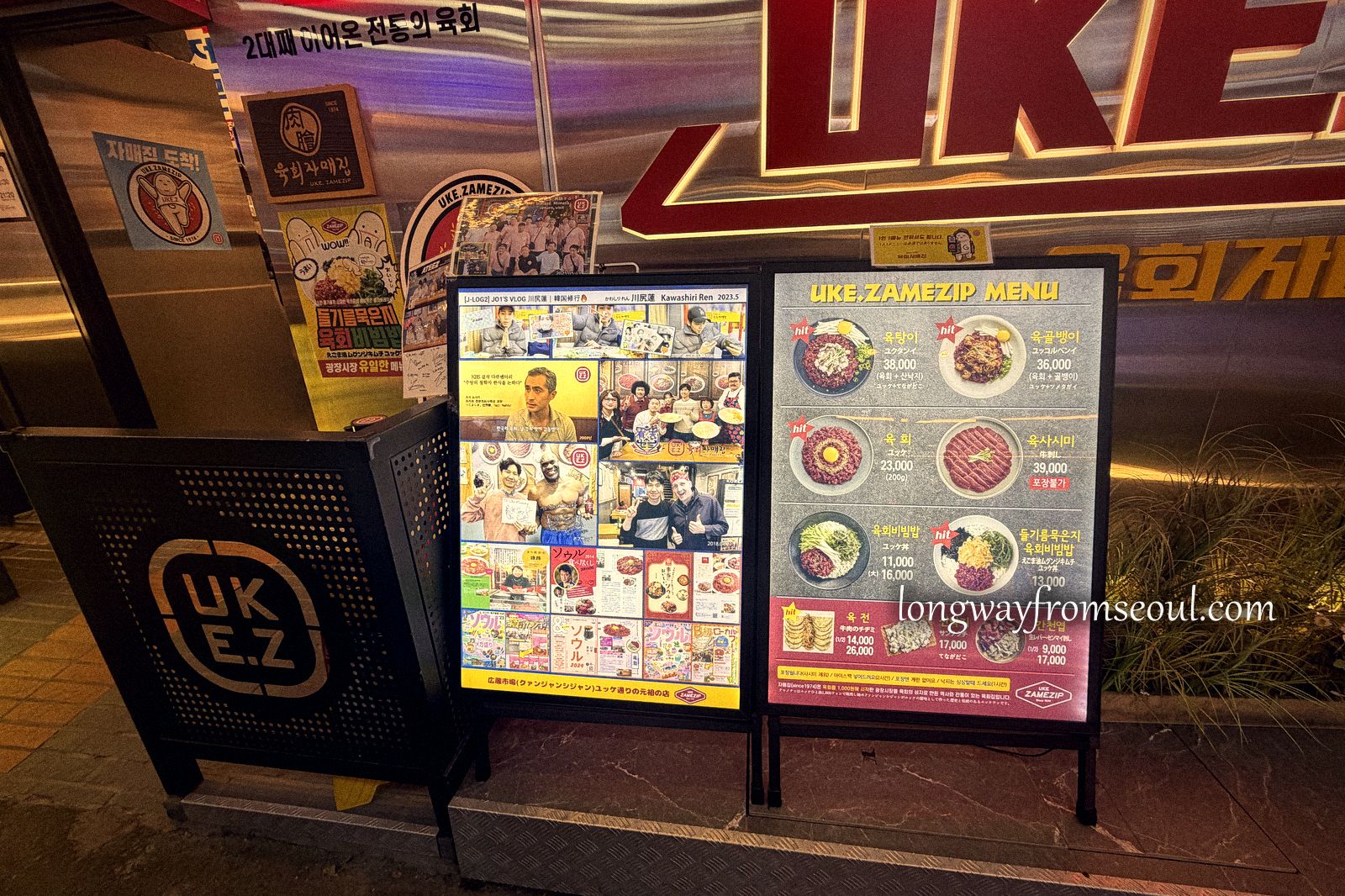
On raw beef and raw octopus, the honest answer: this is a normal thing to eat in Korea, these shops are inspected, and the beef is cut to order. If you do not eat raw meat at home, this is not the night to start, and the market has four hundred other things. If you do — it is very good, and it is colder and sweeter than you expect.
Yukhoe Jamae-jip, main store · 육회자매집 본점
200-4 Jong-ro, Jongno-gu, Seoul — Yukhoe Alley
Open in Google Maps · Expect a queue at the main store · one order is fine for a group · takeaway available except the sashimi
4. Cheonggyecheon — walk west, and time it
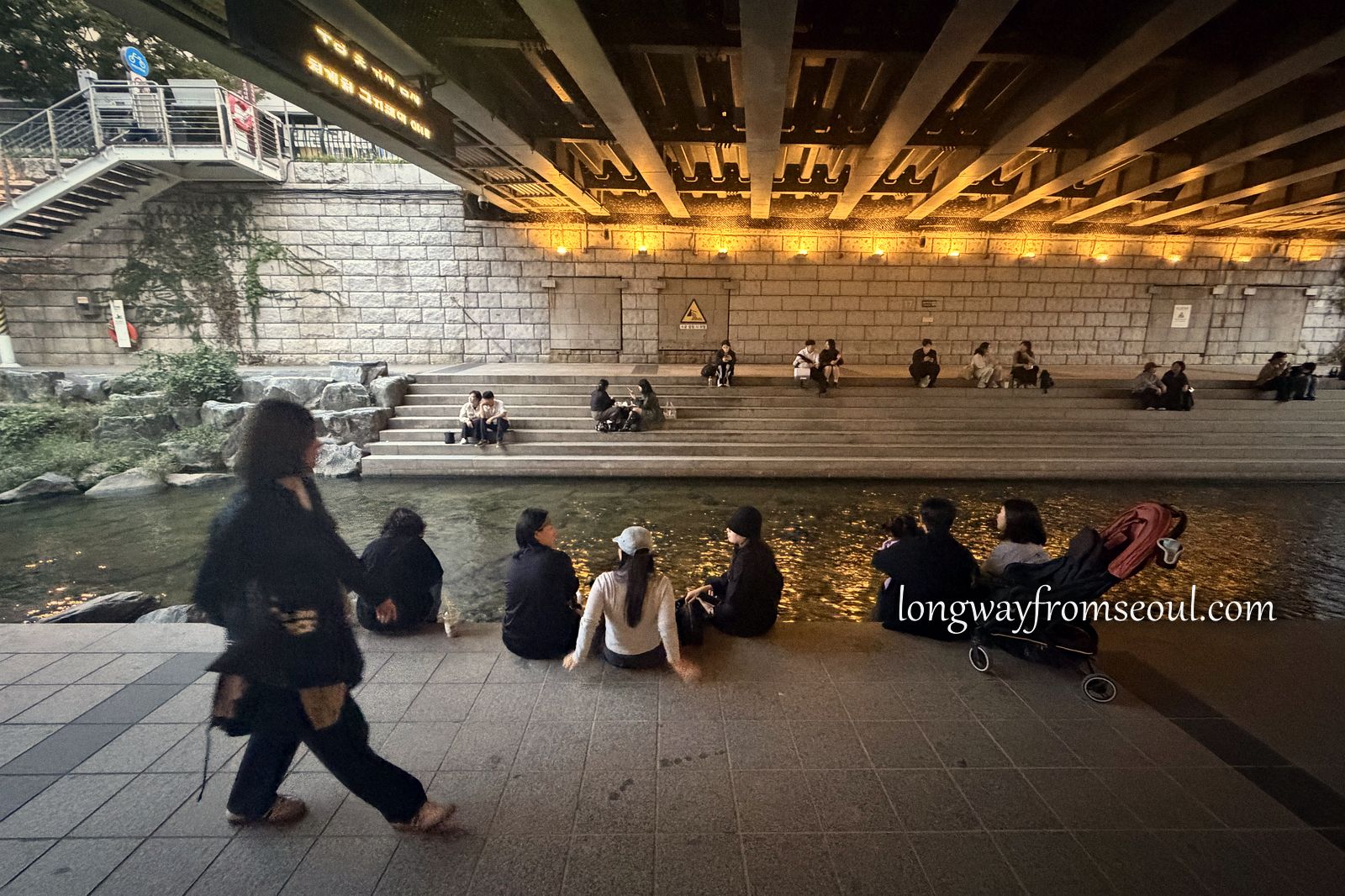
Four minutes from the market you drop down a staircase and the city goes quiet. Cheonggyecheon is a stream that ran under an elevated motorway for thirty years until the road was pulled down. The city agency that runs it gives the restored stretch as 5.8 kilometres, from Gwanghwamun down to Seongdong-gu, finished on 1 October 2005.
You want to go west, upstream, towards Gwanghwamun. That is the direction the sunset is in.
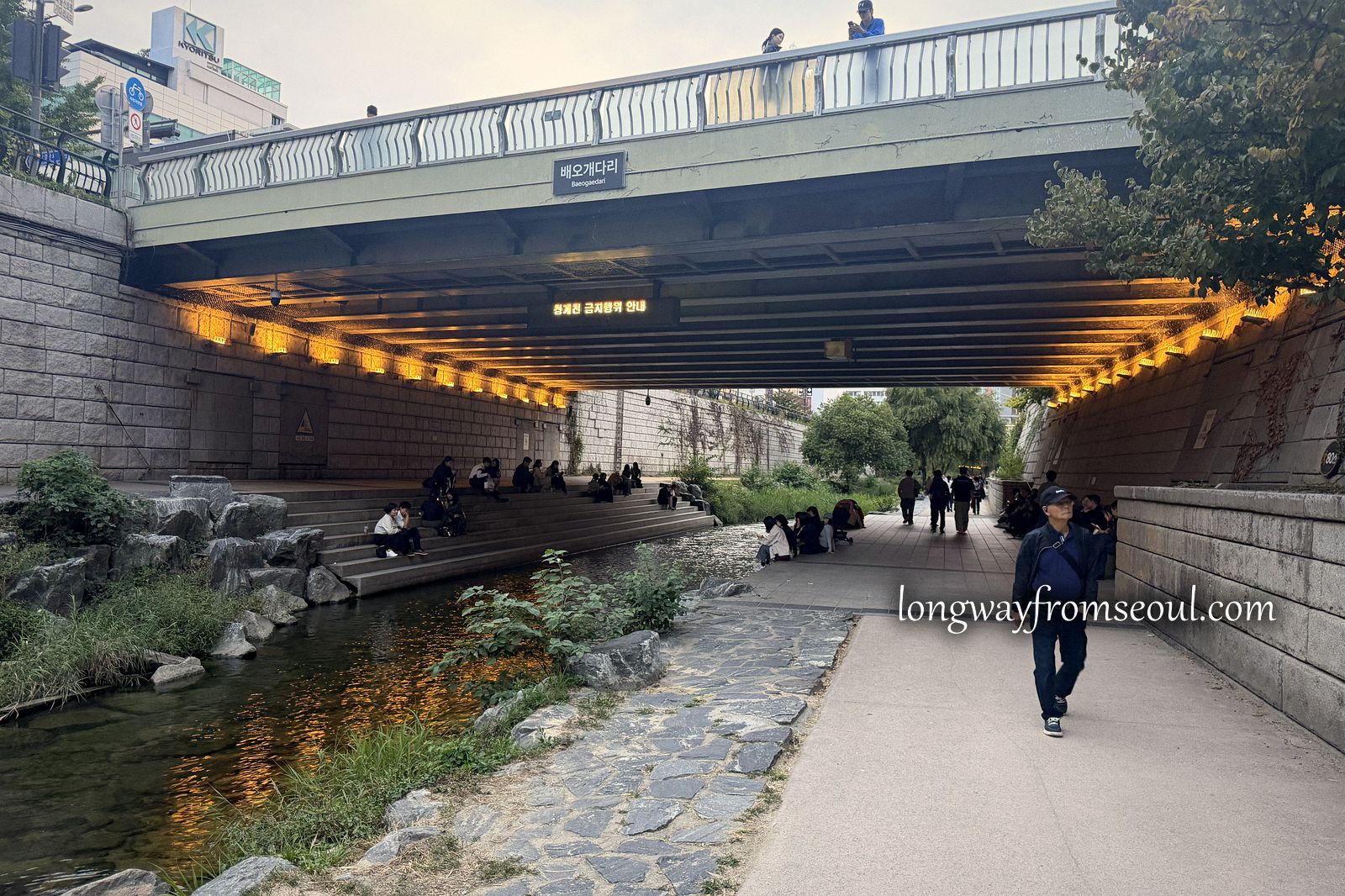
There are stepping stones every few hundred metres, flat slabs set across the water, and crossing on them is the single most photographed thing on this walk for a reason. People sit on the stone steps along the bank with their shoes off and their feet in the water. In October the water is cold enough to be a decision.
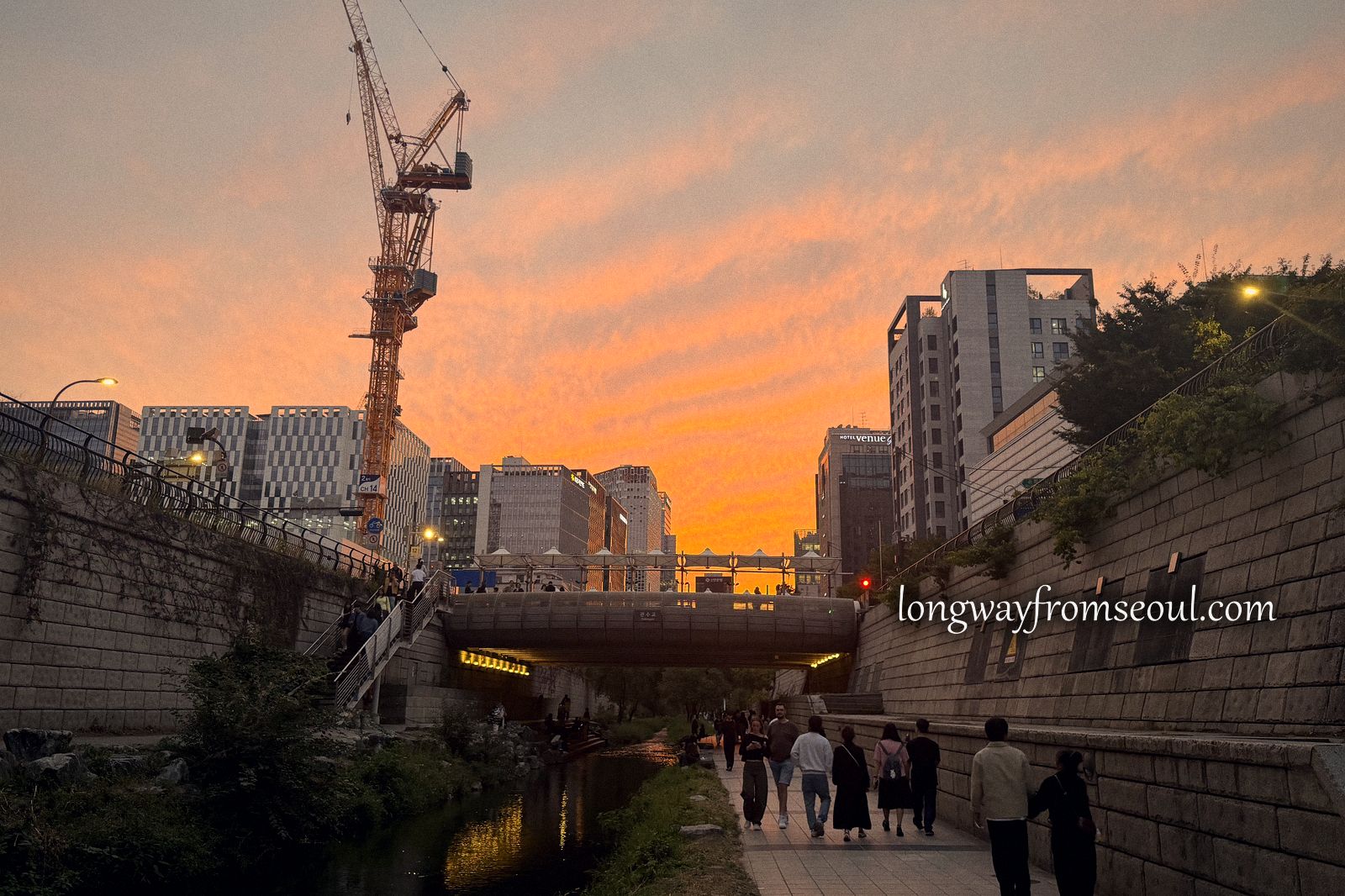
This is what we came for, and it lasts about fifteen minutes. The west-facing stretch near Seun Sangga puts the sun straight down the channel between the walls.
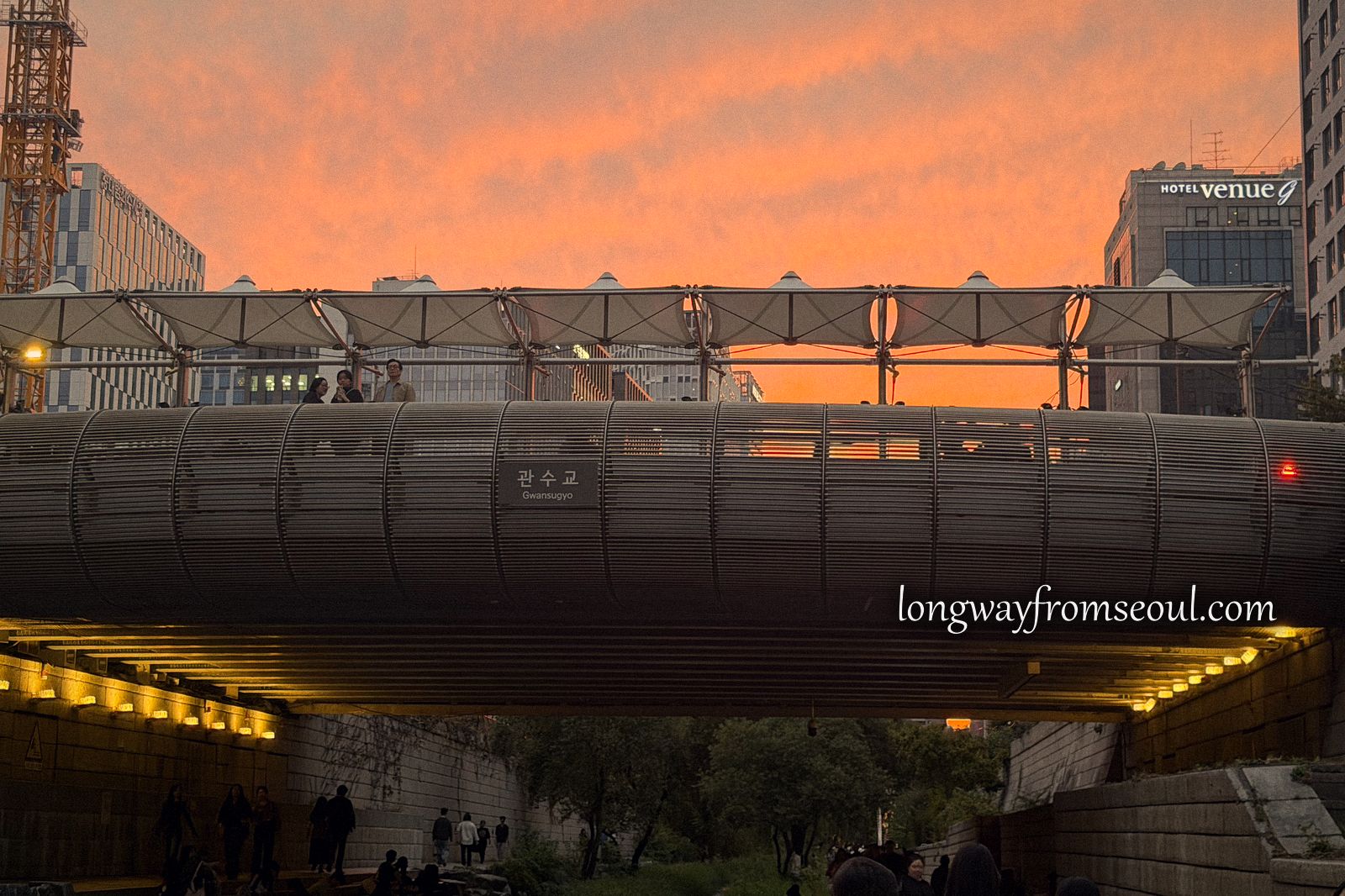
Then the bridge lights come on underneath, and the whole thing changes character again, and that is your cue to climb out and go to Euljiro.
Cheonggyecheon stepping stones · 청계천 빅돌다리
Cheonggyecheon-ro, Jongno 3-ga, Jongno-gu, Seoul
Open in Google Maps · Free, open always, lit at night · stairs down at most major crossings · flat and step-free along the bank
Sunset stretch, by Seun Sangga · 세운상가 근처
Cheonggyecheon-ro, Jugyo-dong, Jung-gu, Seoul
Open in Google Maps · Aim to be here 20–30 minutes before sunset · check the day’s sunset time, it moves nearly two hours between June and December
5. Euljiro after dark
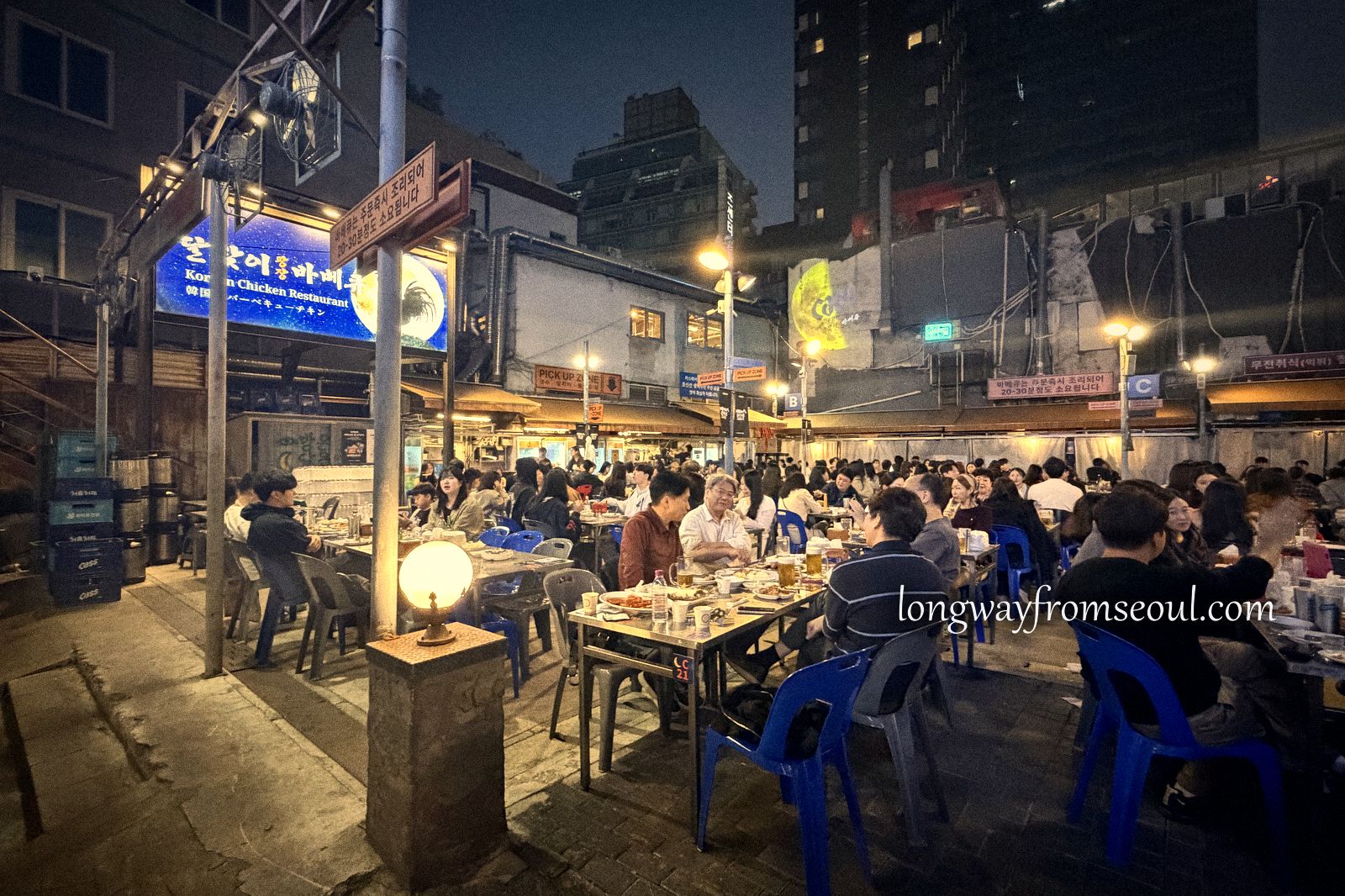
Euljiro in the daytime is lighting shops, printers, tile wholesalers and machine parts. After about seven in the evening the shutters come down, plastic tables go out on the street, and the same alleys become the best place to drink in Seoul.
The blue plastic stools are the signal. You sit outside, in the road, between parked scooters, and somebody brings you a grill.
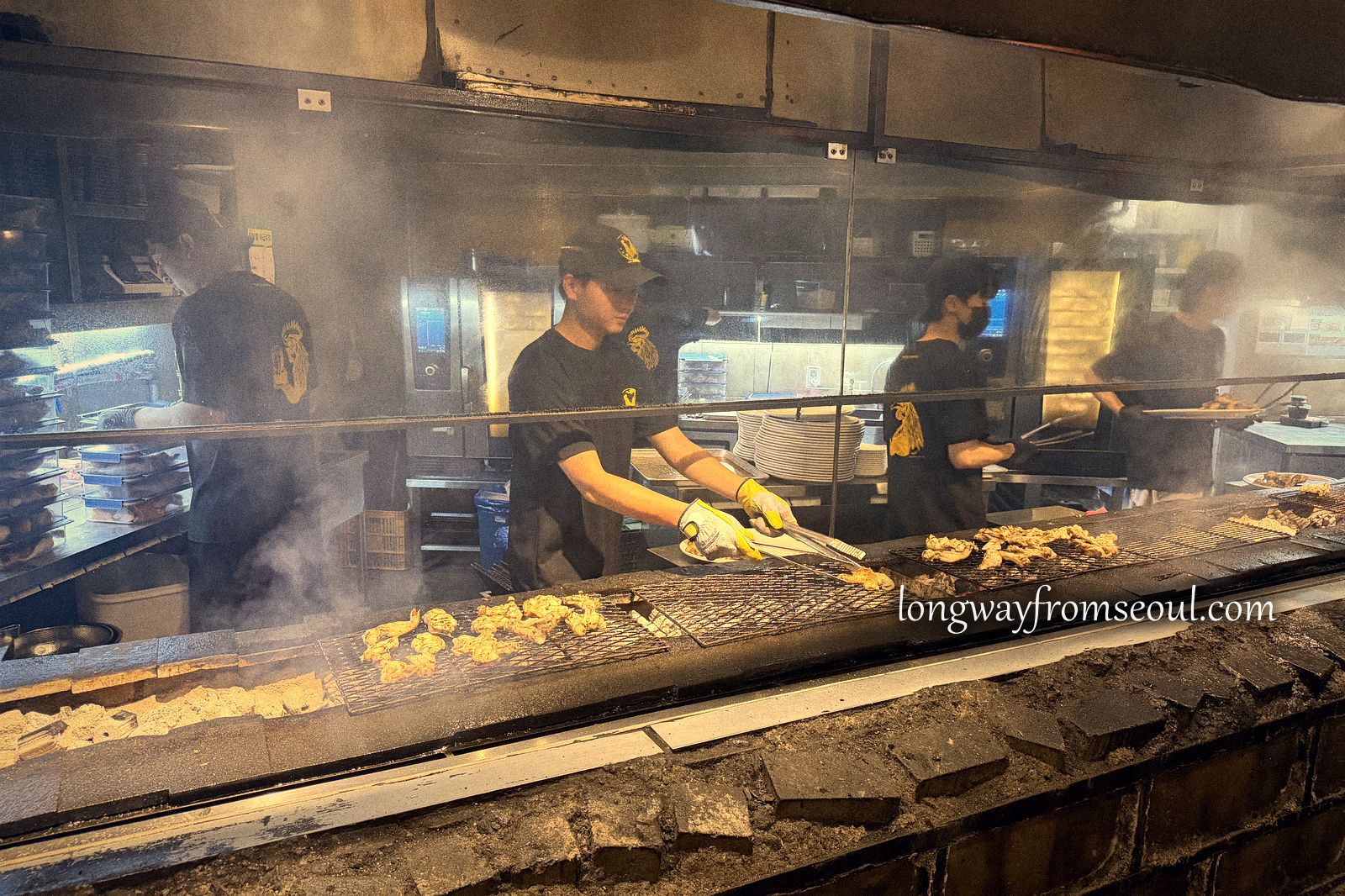
Order the pork belly or the gopchang, get a beer, and do not expect a menu in English. Pointing works. Everybody here is pointing.
Euljiro grill alley · 을지로 구이골목
Euljiro 3-ga station area, Jung-gu, Seoul 04543 — exits 10 and 11
Open in Google Maps · Tables out from roughly 18:00 · cash still easiest at the smaller stalls · busiest Thursday to Saturday
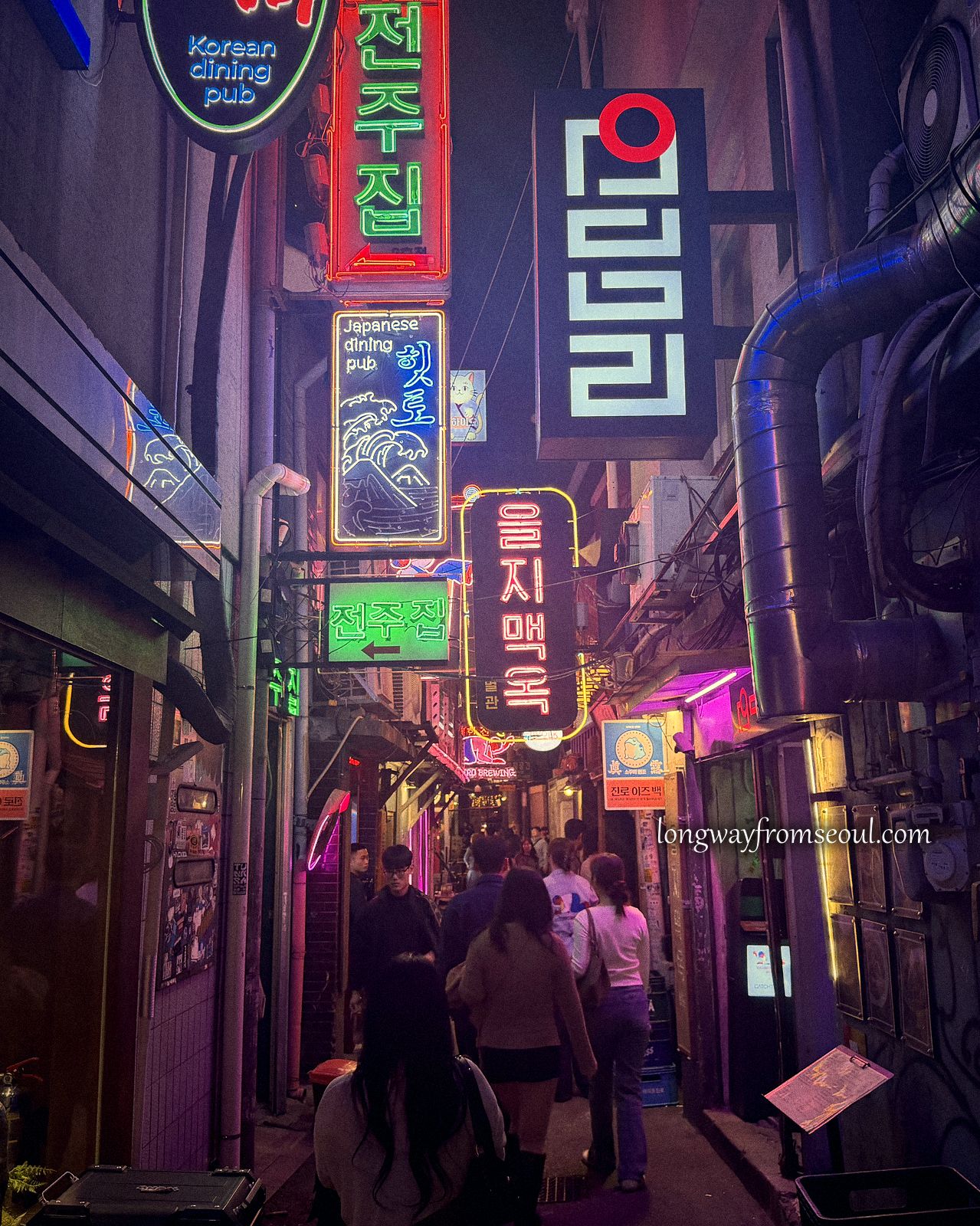
One street over, the neon. These alleys are barely two metres wide and the signs are stacked four storeys up both sides of them, and at night the whole corridor turns magenta and green. This is the stretch everyone has seen a photograph of without knowing where it is.
Euljiro neon alley · 을지로 네온 글목
Chungmu-ro 5-gil, Jung-gu, Seoul 04550
Open in Google Maps · Best after 20:00 · narrow and busy — stand to one side to photograph
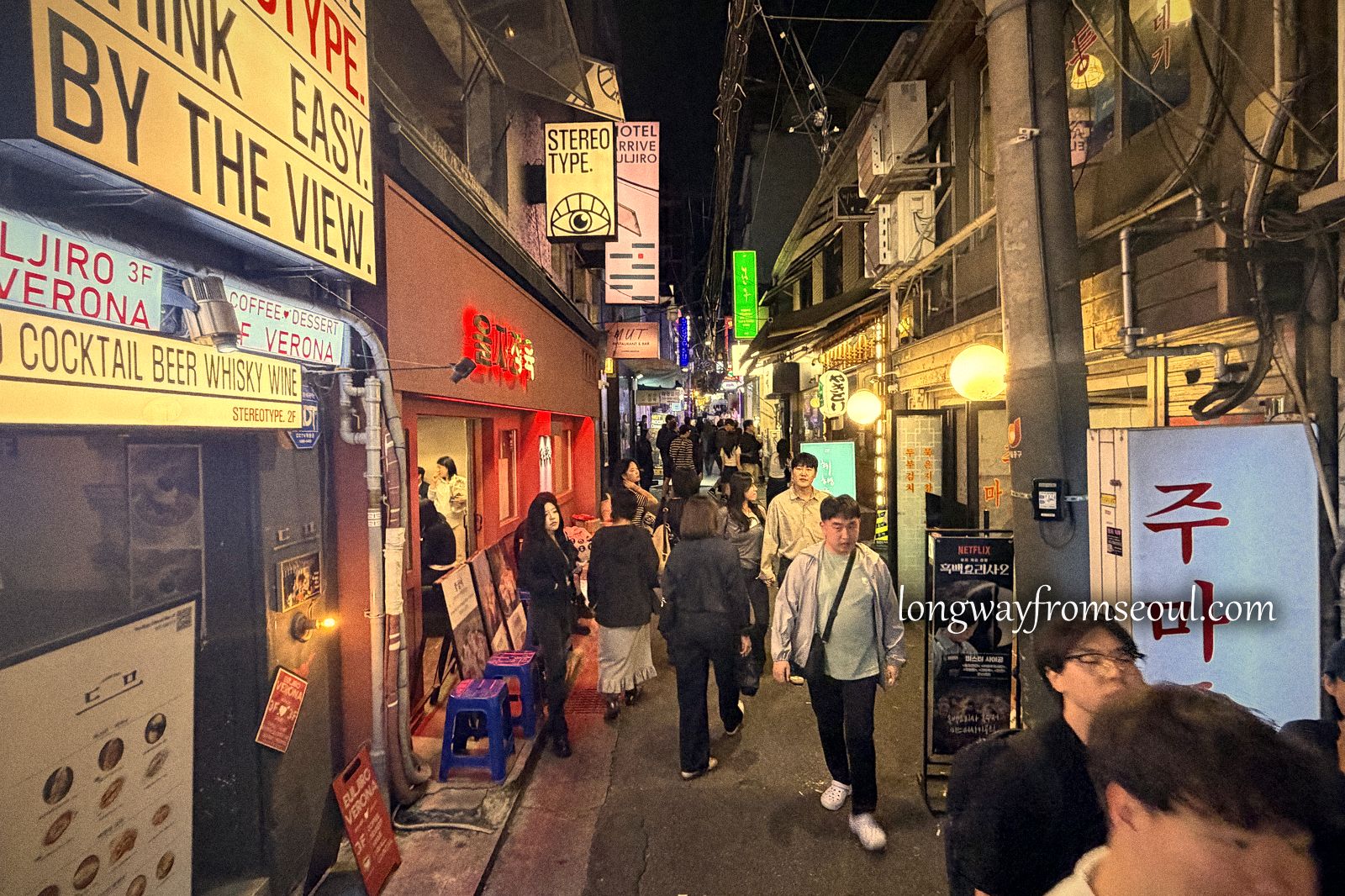
And then Nogari Alley, which Seoul added to its Future Heritage register in 2015. Its whole business is draft beer and nogari, dried young pollock, grilled and torn apart with your hands. It started as what the printing workers did at the end of a shift and it is now several hundred people on plastic chairs in a street.
Go sooner rather than later. Parts of this block sit inside a redevelopment area, and the Future Heritage label is honorary — it comes with a plaque and almost no protection.
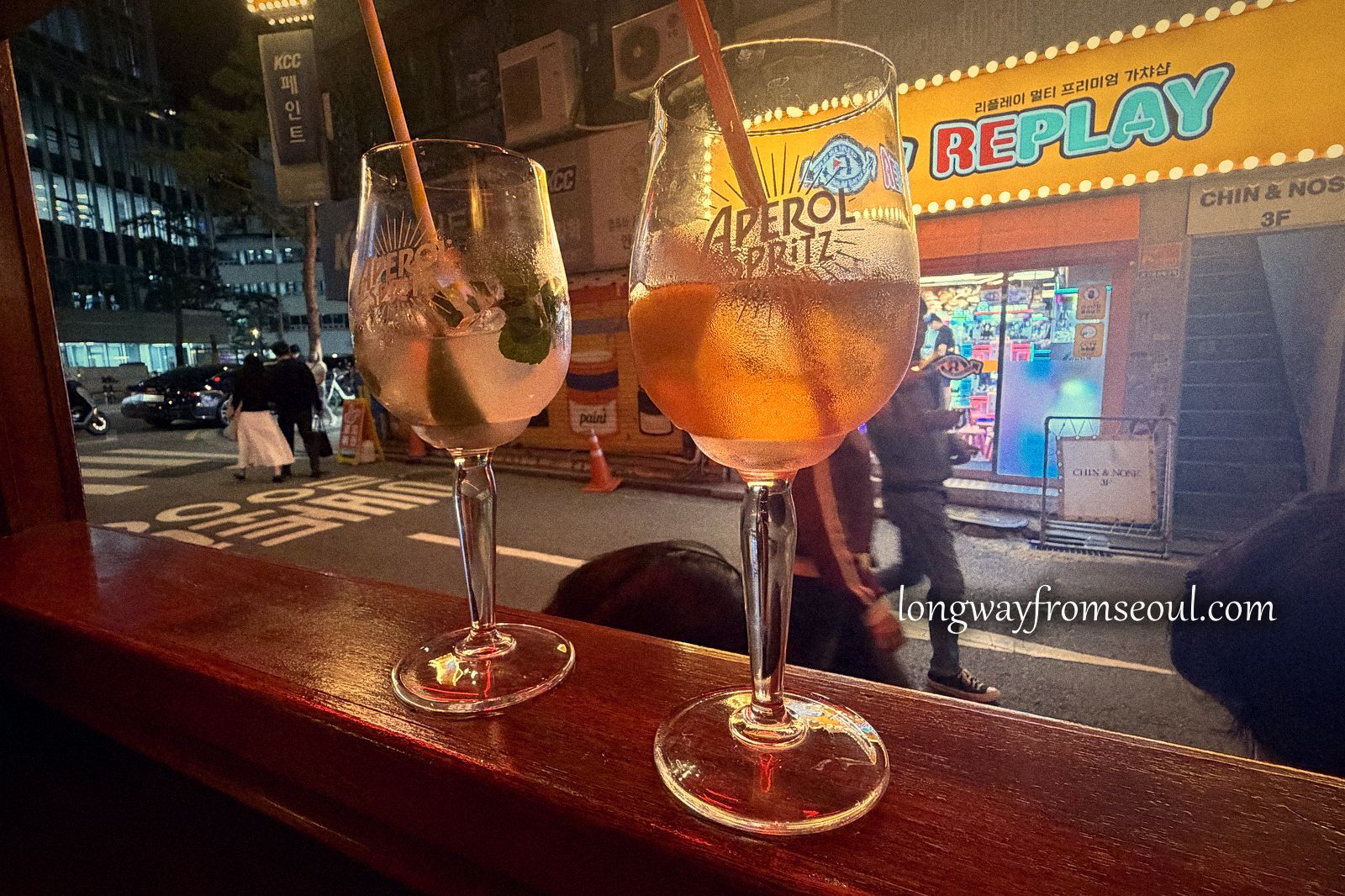
We finished in a bar off the main alley, up a staircase, with a window over the street. I am not going to name it, partly because we did not write it down, and mostly because the finding is the point in Euljiro. Pick a staircase with a small sign and go up it.
Nogari Alley · 노가리 글목
Around 15 Eulji-ro 13-gil, Jung-gu, Seoul — Euljiro 3-ga
Open in Google Maps · Seoul Future Heritage, designated 2015 · from about 18:00 · outdoor tables, so weather-dependent
The practical box
Getting there
- Gwangjang Market — 88 Changgyeonggung-ro, Jongno-gu. Jongno 5-ga station (Line 1), exit 8. Euljiro 4-ga (Lines 2 and 5) also works.
- Finish at Euljiro 3-ga (Lines 2 and 3), which puts you two stops from Myeongdong and four from Seoul Station.
- A T-money card from any convenience store covers the whole day; a single ride is about 1,500 won.
Timing
- 17:00 start. Market first while it is light, stream for sunset, Euljiro after dark.
- Check the day’s sunset time before you go — in Seoul it moves from about 17:15 in December to 19:55 in June, and the whole plan hangs off it.
- Saturday is the fullest and the most fun. Sunday is quieter and a lot of the market’s non-food shops are shut.
Money
- Cards work almost everywhere now, including market stalls. Carry 30,000–50,000 won in cash for the smallest places.
- Budget: two people can do this entire evening — pancakes and makgeolli, a plate of yukhoe, a grill and beer in Euljiro, and a drink in a bar — for roughly 80,000–110,000 won.
- No tipping. None. Do not try.
Two things worth sorting before you land
→ Travel insurance — the usual, and worth it if raw beef is new to you
Those two are the only things on this page I would nudge you about, and when I have accounts with providers I trust I will say so here plainly and tell you I earn from it.
Why this walk and not the other ones
Seoul has a lot of evenings on offer and most of the lists point at the same four places. The reason we keep coming back to this one is in the first thirty seconds of the film: look at who is sitting at the counters.
Gwangjang has a tourist problem precisely because it is good, and the city is in the middle of doing something about the part of that which was going wrong. Euljiro has not been tidied up at all yet. Cheonggyecheon is free and it is where Seoul goes to sit down. Between them you get a version of the city that is being lived in rather than performed, which is the only kind worth photographing.
The film, and the next one
EP.01 is at the top of this page and on GRACE H.R. Every episode gets a written guide here with the addresses and the real prices, published the same day.
The subscribe box below is the only place I announce one. One email per story, nothing else, ever.
Elsewhere on this site: the other thing we do is Italy, slowly — walking across Rome in a day, and what actually happens at an Italian car rental counter, which turns out to be the same lesson as the Gwangjang water bottle: check the price before you say yes.
All photographs taken on 3 October 2026 between 16:30 and 23:00. Every price on this page was read off the shop’s own order sheet or menu board in a photograph from that day — but prices change, so treat them as the shape of the thing rather than a quote. Enforcement details are from the Seoul Metropolitan Government and Jongno District Office announcement of 20 May 2026.